My regal jumping spider doing her thing.
Phidippus regius, commonly known as the regal jumper is a species of jumping spider (family Salticidae) found in parts of the United States and the Caribbean. It is the largest species of jumping spider in eastern North America
His name is Morgan to honor Morrigan, a powerful, multifaceted Celtic goddess of war, fate, death, and sovereignty. She’s a fierce deity, symbolizing the wildness of nature and destiny, with strong links to ancient Irish mythology.
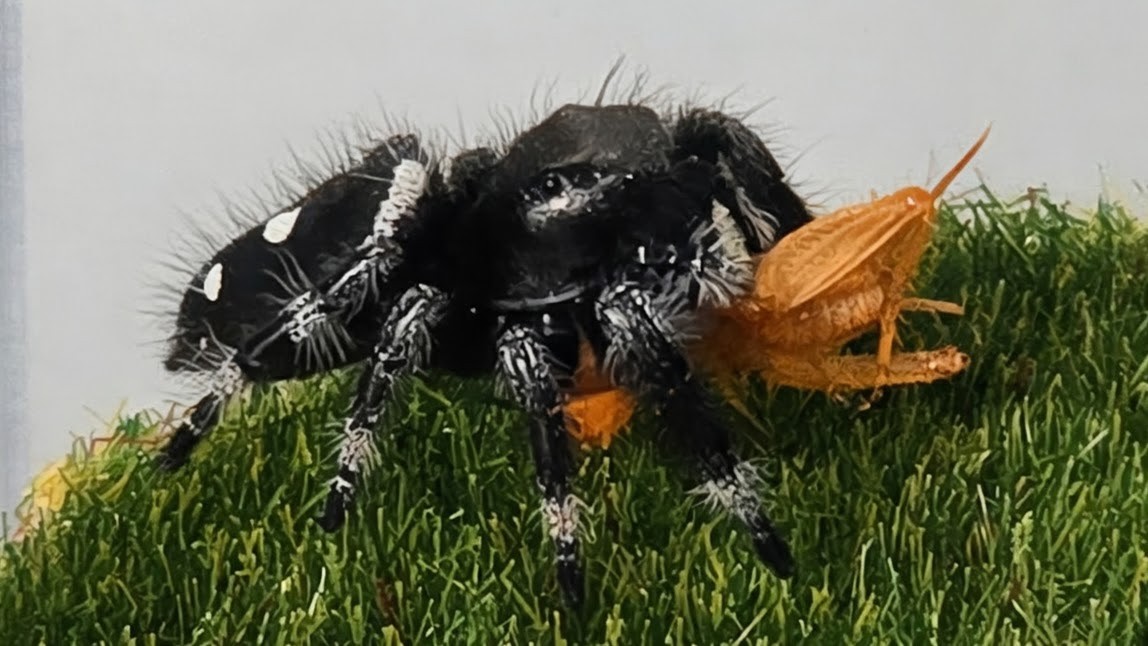
I will be adding photos soon. More as I take more. I have also setup a live stream of her. You may have to look around for her. You should also see the occasional dinner guest, normally a small cricket.
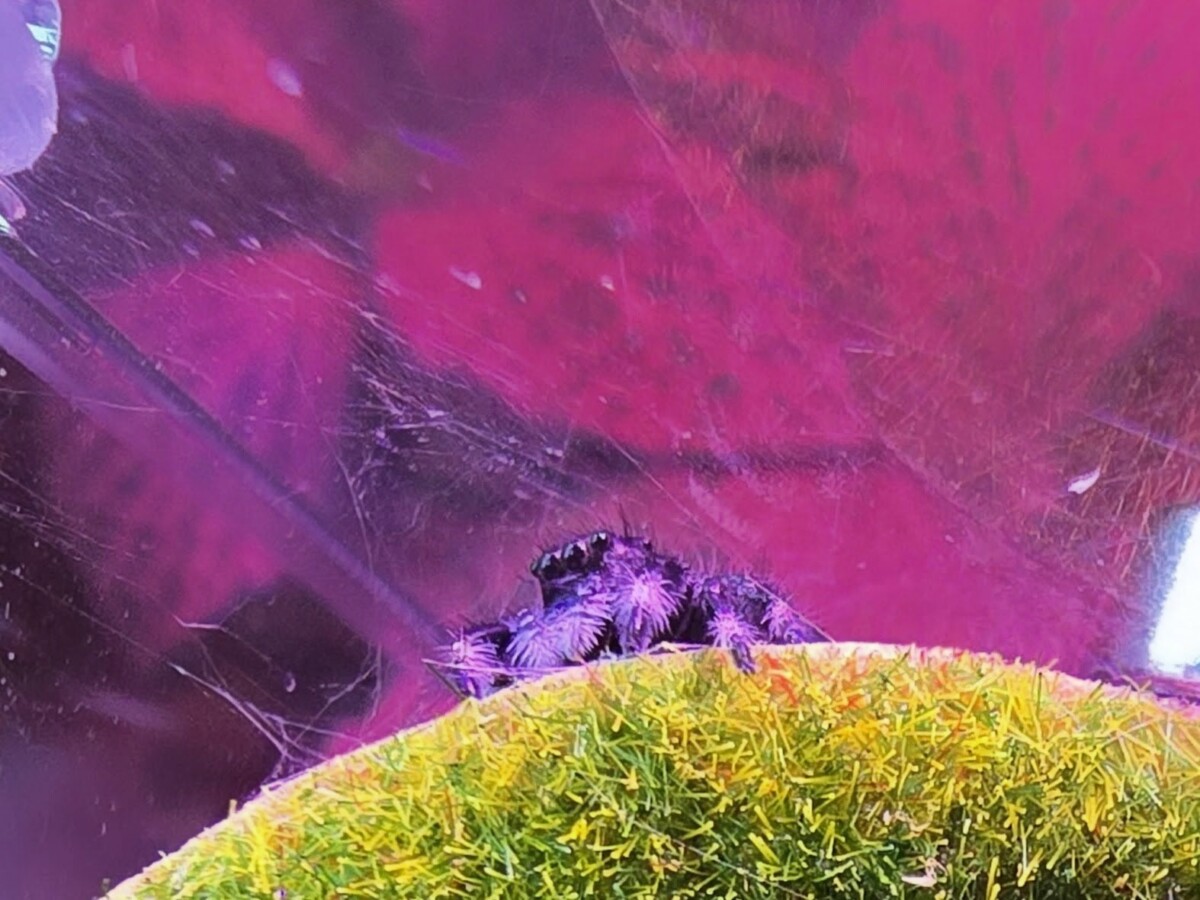
Time to start a photo album for her. Here is the first one, she is being curious and cute.
The Science of Cute: A Day with Morrigan the Regal Jumping Spider
In the world of macro photography, few subjects are as cooperative—or as charismatic—as the jumping spider. With two large, forward-facing eyes and a habit of tilting their heads to look back at you, they bridge the gap between “bug” and “pet.”
This week, I’m sharing a closer look at Morrigan, my female Regal Jumping Spider (Phidippus regius). While she may look like a tiny plush toy, her anatomy is a marvel of biological engineering. Through these photos, we can explore the physics and mechanics that make her such a successful hunter.
1. The Emerald Smile: Structural Coloration
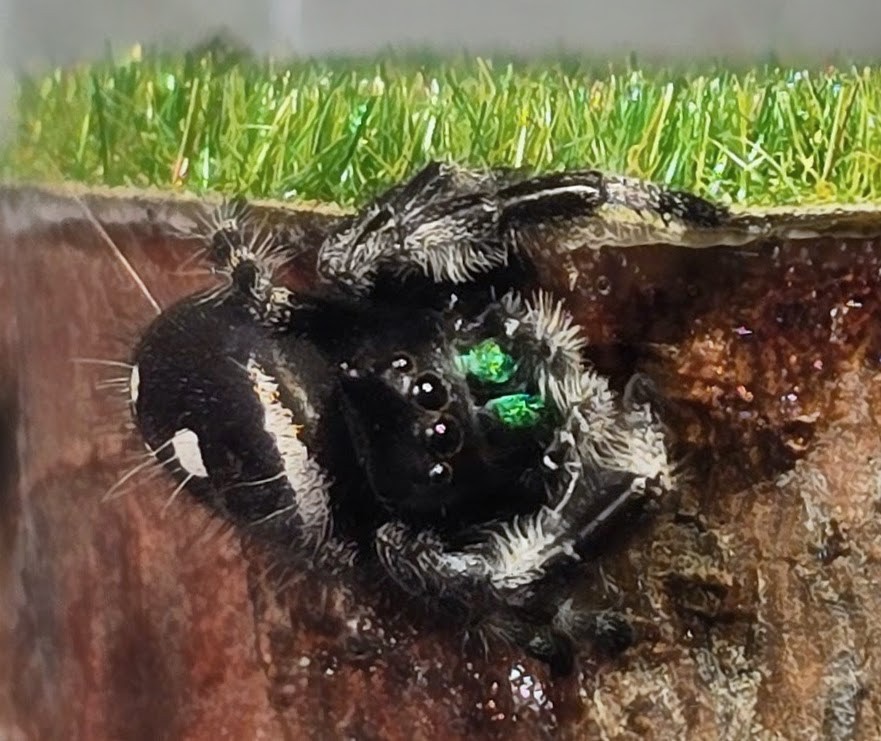
In her portrait, the first thing you notice is the dazzling, metallic green color of her chelicerae (the mouthparts covering her fangs).
It looks like polished metal, but if you were to touch it, no green pigment would rub off. This is a phenomenon called structural coloration.
The surface of her jaws is covered in microscopic, transparent layers of chitin. When white light hits these layers, it refracts (bends) and reflects off the different surfaces. Through thin-film interference, the light waves interact with each other. In Morrigan’s case, the layers are spaced perfectly to cancel out other wavelengths while amplifying the green ones. It is the same physics that gives color to a soap bubble or an oil slick—nature painting with geometry instead of dye.
2. Hydraulic Propulsion
Morrigan isn’t just a sitter; she’s a jumper. Jumping spiders can leap up to 50 times their body length. But unlike a grasshopper, which uses massive leg muscles like springs, spiders use hydraulics.
To make a jump, Morrigan rapidly alters the pressure of her hemolymph (spider blood). By contracting muscles in her cephalothorax (head section), she forces fluid into her legs, causing them to extend instantly. This sudden spike in hydraulic pressure launches her through the air with precision targeting.
3. Defying Gravity: Van der Waals Forces
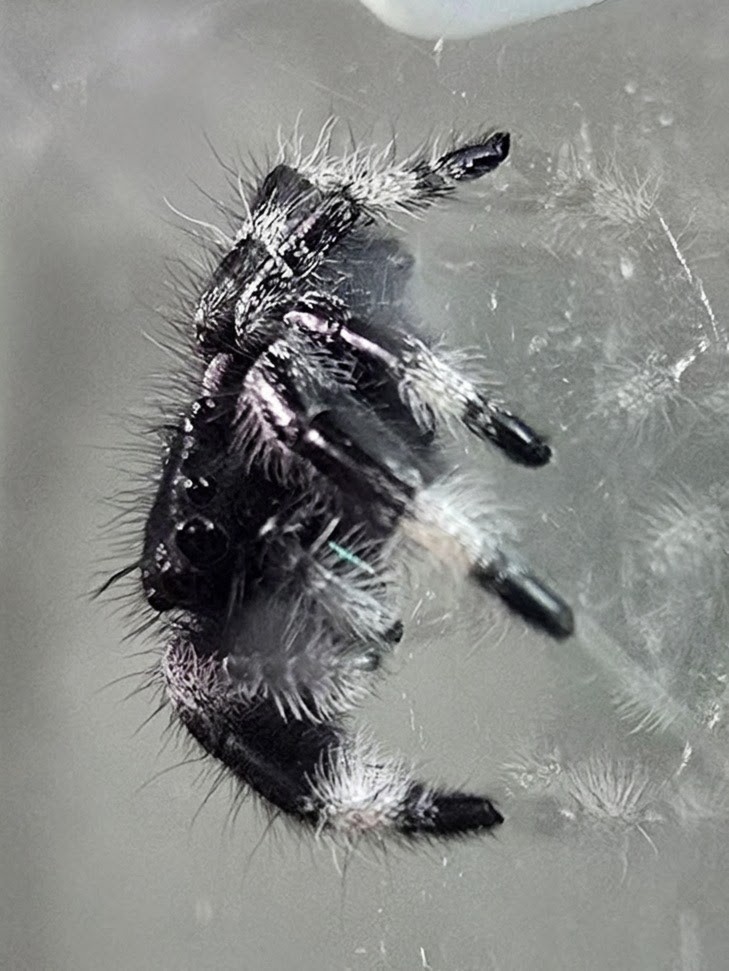
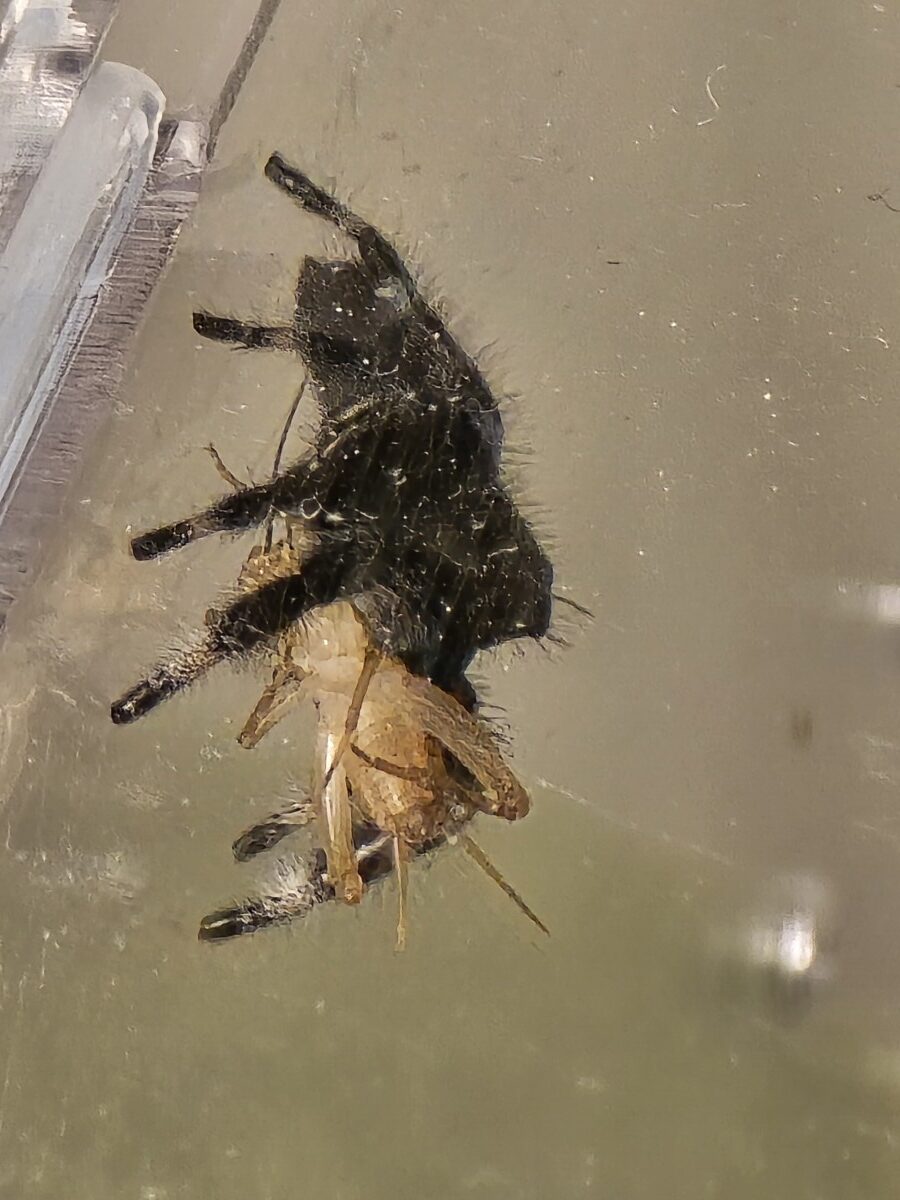
In one of the photos, you can see Morrigan casually hanging upside down on smooth glass while wrestling a cricket. How does she stick to a surface that is seemingly perfectly smooth?
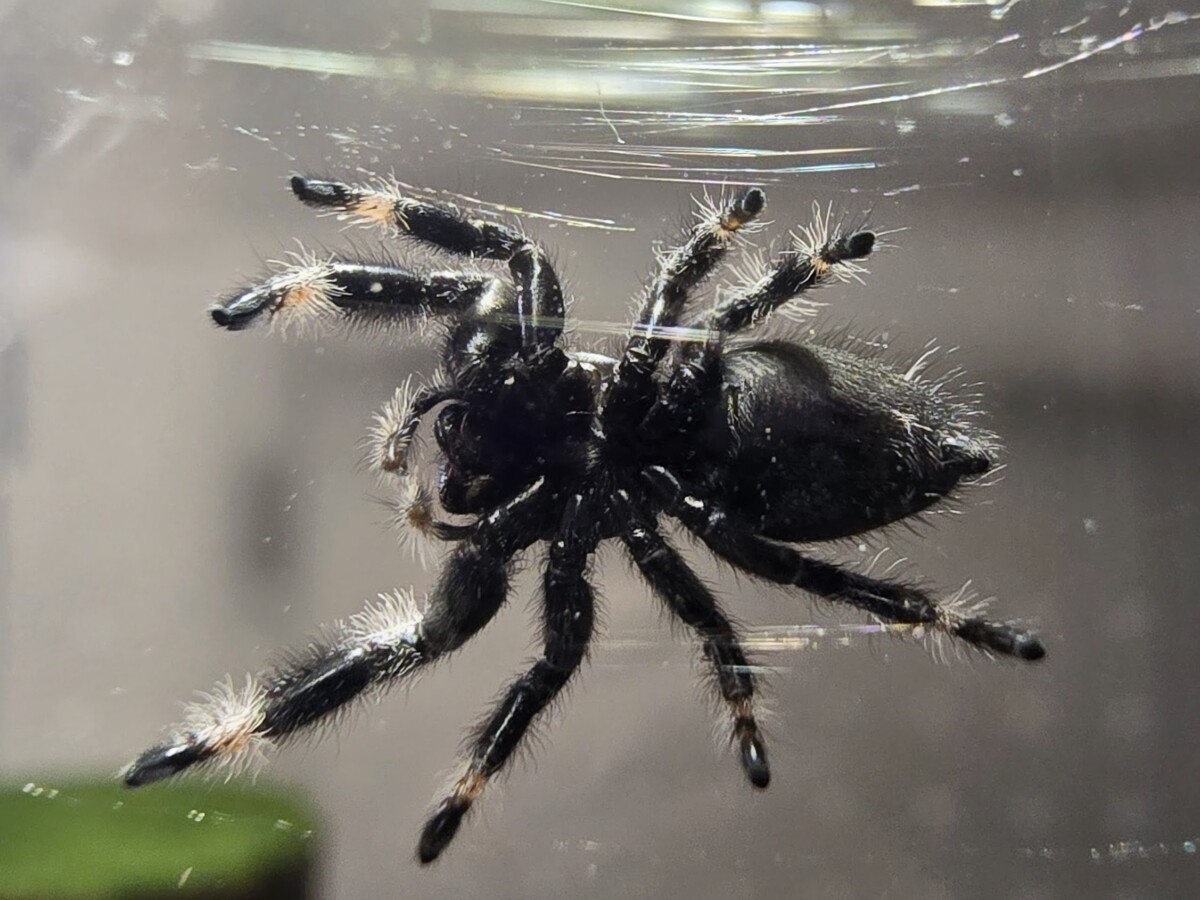
The answer lies in the scopulae—dense tufts of microscopic hairs on the bottoms of her feet (visible in the ventral photo). Each hair splits into thousands of even smaller “end feet” called setules.
This creates so much surface area contact that Van der Waals forces take over. These are the weak electric attractions between individual molecules. While a single bond is weak, the millions of contact points on Morrigan’s feet create an adhesive force strong enough to hold her weight—and the weight of her dinner—even when upside down.
4. The Hunter’s Vision
Unlike web-building spiders that rely on vibration, Morrigan is a visual hunter. Her two large central eyes function like telephoto lenses, giving her high-resolution vision to spot prey from a distance.
Because her exoskeleton is rigid, she cannot move her eyes. Instead, the retinas inside her head move. If you look closely at a live jumping spider, you can sometimes see the color of the eyes shift as the boomerang-shaped retinas sweep back and forth, scanning the room for movement.
Whether she is posing for a portrait or taking down a cricket, Morrigan is a reminder that some of nature’s most sophisticated technology comes in very small packages.